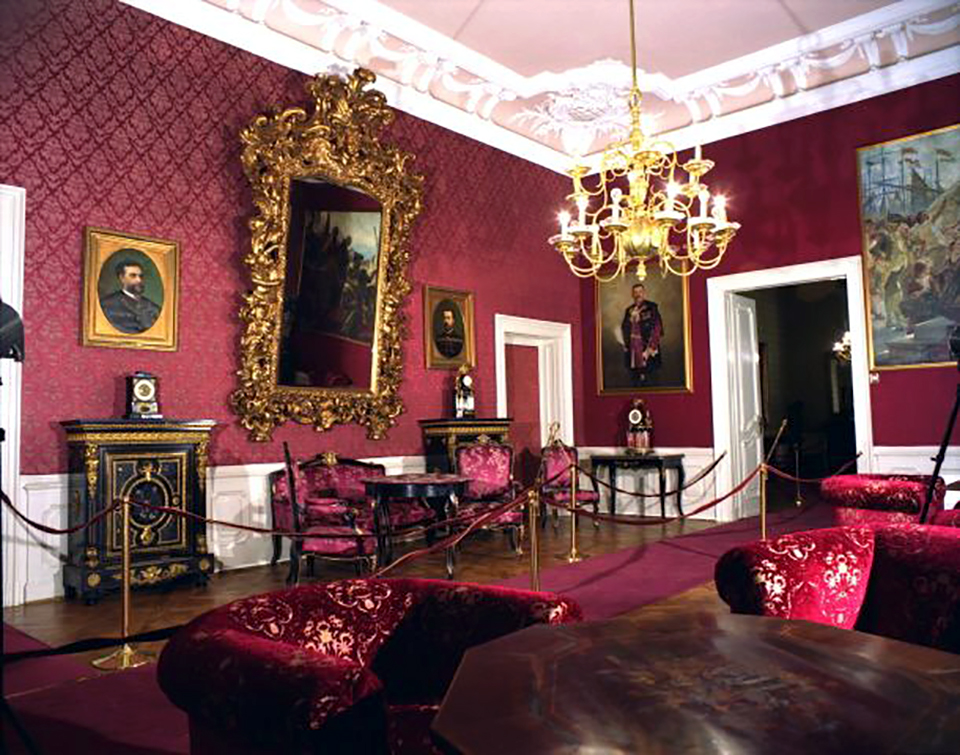

THE RED SALON
In 1893, Hauszmann originally designed the room to be the governor's study, where he could work in peace. In order to prevent interference with his work, he had a private staircase leading to his study from his living quarters on the second floor. Privacy was all the greater because the study was connected to the Atrium. The adjacent Green Salon was also used as the governor's working space, yet it was a much busier and noisier place, mostly intended to receive clients. The governor's study was connected to another small room – a reference library.
The governor’s study was divided into an office with desks and a lounge with a sofa and armchairs. The governor’s desk, made of high-quality oak, has been preserved. The desk-top was covered with carmine fabric, and the sides were decorated with reliefs. The most interesting are the side reliefs showing a male figure with angels – most likely a stylized presentation of the martyrdom of St. Vitus, the patron saint of Rijeka.
The iconographic images and symbols related to the City of Rijeka are often times present in the decoration of furniture custom-made for the Governor’s Palace. The furnishing of the Palace took several years after its construction (1896), and it is known that the furniture was made based on the designs and under the direction of architect Alajos Hauszmann himself.
The room also served as a study for Gabriele D’Annunzio, where he held his meetings. The 1920 artillery strike (during D’Annunzio’s rule) left the room slightly damaged, but it was soon reconstructed in 1923.
During the major reconstruction of the Palace in 1938 by the administration of Italian Carnaro (Kvarner) Province, the room was turned into a Smoking Longue, connected to a dining room which today is the Green Salon. The walls were lined with red silk wallpaper, hence the name Red Salon, which is still in use today.
As a part of the extensive renovation and rearrangement of the original Hungarian division and allocation of space conducted during Italian rule, the rooms on the first floor of the eastern part of the Palace were turned into salons, and those on the second floor into guest rooms. Such an arrangement created savings on heating costs, as the eastern block of the Palace was only heated when distinguished guests stayed there.
After World War II, the Central Culture Hall operated in the Palace, the salons hosted social gatherings, a reading room and the of the Presidency of the City People’s Committee.
Once the Museum assumed management of the Palace, the evocatively-decorated salons on the first floor were open to public and leased to companies and embassies for business conferences.
The Red Salon was renovated in 1970, ahead of then Yugoslav President Josip Broz Tito’s visit to Rijeka for the 25th anniversary of the city’s liberation.
Marking the 100th anniversary of the Palace’s construction, a new Museum display was presented on the first floor of the Palace, intended to exhibit the changes in furniture styles from the Renaissance to the 19th century.
Today, the Red Salon exhibits portraits of Rijeka’s governors and the original furniture of the Governor’s Palace, with the most impressive piece – the governor’s desk.