

ATRIUM
The first floor features the most representative room of the Palace. According to architect Alajos Hauszman's 1893 design, it was initially intended for hosting and official protocol and ceremonies.
The Atrium is the central space on the first floor. A monumental marble staircase leads to it from the ground floor. It has 300 square meters of floor space and is two stories high. There is an impressive skylight on top, allowing sunlight in. The use of that type of iron and glass construction was considered cutting-edge technique at the time of the Palace's construction.
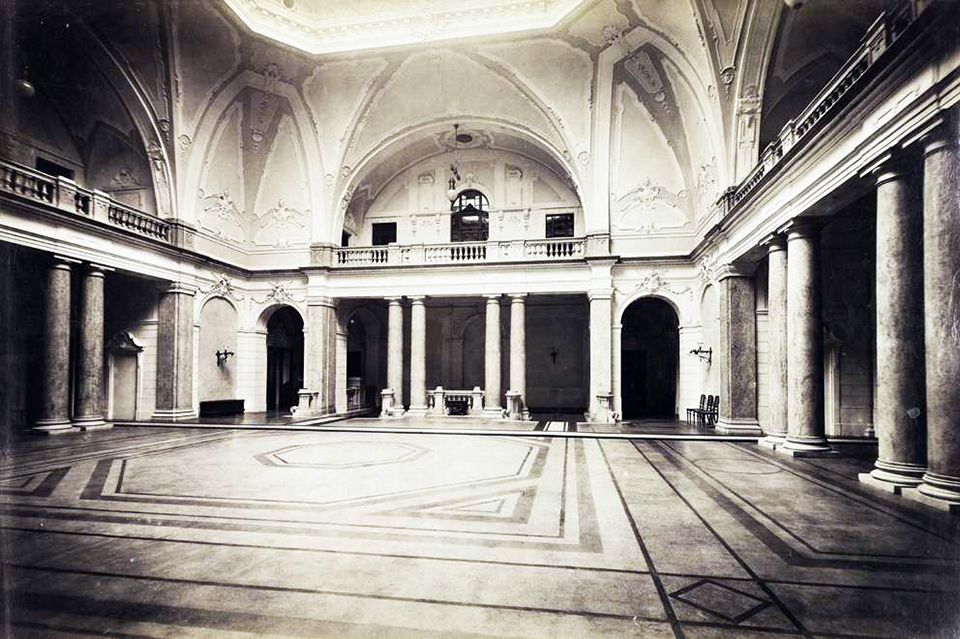
The Atrium is located centrally on the 1st floor and surrounded by salons, a ballroom (today the Marble Hall) and utility rooms. The Atrium’s northern, eastern and western walls are slightly recessed and the strict rectangular layout is followed by two pairs of pillars between the pilasters on each side, lined with plaster imitating marble (Ital. stucco romano). The colonnade emphasizes the monumentality of the space, while porticos conceal numerous doors connecting the Atrium to almost every room on the 1st floor.
There is a number of utility rooms on the 1st floor, used by servants and carefully hidden to avoid disrupting the general appearance and impede movement through the salons. The salons and the ballroom were connected, allowing for circular movement through the floor. Furthermore, the ballroom and all salons, with the exception of the south-eastern and south-western corner salons, are connected to the Atrium. The construction was inspired by the Ancient and Roman civil and imperial villas built as a series of rooms around the main, open yard – the atrium. The same principle was applied to the Renaissance villas of Italy’s prominent architect, Andrea Palladio (Padua, 30 Nov. 1508 – Vicenza, 19 Aug. 1580) who strongly influenced architecture throughout the 18th and 19th centuries.
The Atrium’s major source of light is the glass roof construction and four small sconces that were at the time installed on the corners, at the position of today’s mirrors. During renovation under the Italian rule in 1938, four chandeliers were added along with ceiling lamps in the porticos, to which the original sconces were also moved from the Atrium.
The original floor was made from chips of stone and marble using the terrazzo alla veneziana technique. Since the Rijeka–Zagreb railway tunnel, built in 1873, passes under the Palace, the constant vibrations caused cracks that had to be repaired on a regular basis. A comprehensive reconstruction took place under Italian rule, while the most recent one was conducted in 2007.
Since World War II, when the Maritime and History Museum of the Croatian Littoral Rijekaassumed management of the Palace, the Atrium has often hosted exhibitions and numerous social and cultural events.
