

WHITE SALON
The ambience of the White Salon has been almost entirely preserved, so visitors to enjoy an authentic experience of a late 19th century salon interior. The salon (Hung. Nagy salon – large salon) was used for receptions of distinguished guests. It is located in the architecturally most prominent part of the Palace – on the south side of the first floor – and has access to the terrace. The salon is connected to the adjacent rooms in the western and eastern parts of the Palace and, through two doors on the northern wall, directly to the Atrium.
According to the original design, the White Salon walls were lined by silk wallpaper obtained from the Decorative Fabrics and Carpets Factory, Budapest. The walls are articulated by decorative stucco frames within which the silk wallpaper was fixed by wooden slats. Rich, gilded stucco compositions on the ceiling of the White Salon and other rooms were made by Hungarian sculptor Antal Szabo. An intriguing feature in the salon is the decorative fireplace made of white marble obtained from the renowned Italian quarry in Carrara.
The room's original furniture has been preserved (seating furniture, partition screens, candlesticks and decorative sculptures). All of it was designed by Alajos Hauszmann and authentically renovated in 1996. The furniture is made of white-coated linden and decorated with gilded carvings, while the seating furniture was upholstered with white silk fabric in the Louis XV style. Finding inspiration in historic styles (historicism) was common in the 19th century, while the French Rococo (Fr. rocaille), or the court style of Louis XV and Louis XVI was the most common model for decorating luxurious and representative spaces. The underlying characteristics of the style are the elegantly undulating S-curves and asymmetry, a typical ornament being shells (Fr. coquilles) – an irregular shell-shaped motif.
The Italian artillery strike in December 1920, when D’Annunzio’s arditi were posted in the Palace, left the White Salon severely damaged, but it was reconstructed in 1923.
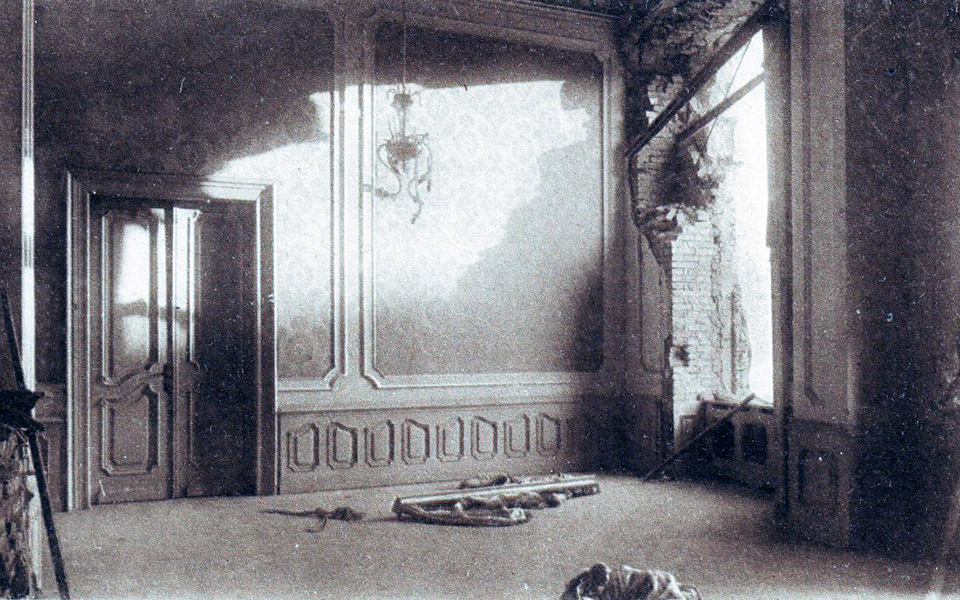
During the extensive restoration of the Palace by the Italian Carnaro Province in 1938, the White Salon, unlike other rooms, underwent no major interventions and was restored in accordance with its original design and function. The silk wallpaper was cleaned and the furniture and the parquet floor were restored.
Following World War II, when the Palace became the city’s cultural hub, the White Salon was preserved in its existing condition and was used like the other salons for various social and cultural events. From 1949 to 1951 Radio Rijeka broadcasts from the White Salon. Once the Museum assumed management of the Palace, the Salon is occasionally leased or used to host exhibitions.


The Maritime and History Museum of the Croatian Littoral Rijeka carried out an extensive restoration of the Salon in 1996, marking the 100th anniversary of the Palace’s construction. The restoration included replacing the worn-out silk wallpaper with new, similar wallpaper and the furniture was restored and upholstered.