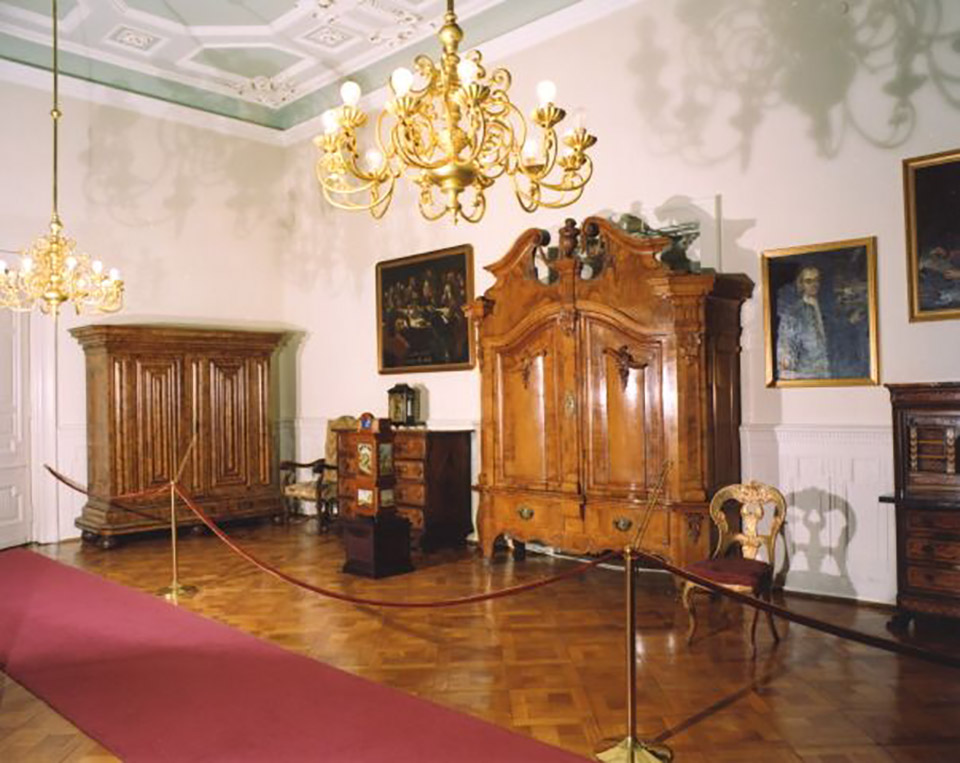

DINING SALON
According to the original Hungarian design, this was a dining room (Hung. ebedlo). The walls were lined with green wallpaper and the woodwork and the wooden wall panels were painted in a cashew colour.
The room was connected to the Small Salon on the south side, with the Serving Room to the north and the Atrium to the east.
The Hungarian design indicates the decoration of the Serving Room – it had deep red (burgundy) coloured walls and a door painted in oak colour. The Serving Room was connected to the kitchen (in the outbuilding) by a concealed, separate staircase and a corridor through the arcade gallery, lest the servants should walk through the main rooms and disturb the governor’s guests.
Preserved documents regarding the construction and furnishing of the Palace show that a large extendable table for 36 and chairs with green upholstery, two cupboards for crockery and kitchen utensils (Ital. credenza) and two serving tables were ordered for the Dining Room and the Serving Room.
During Italian rule (1924-1945), the Dining Room was turned into an office for the secretary and the chief of staff. The wallpaper was removed, the walls painted with lime wash paint, the ceiling stucco was repaired and woodwork was covered with white oil paint.
When the Museum was granted management of the building in 1955, a permanent display on changes in furniture styles and living culture was gradually introduced on the first floor. The display was removed on the eve of the Homeland War in 1991 for safety reasons, and returned in 1996, marking the 100th anniversary of the Palace’s construction. The display was renewed in 2016 and the room today exhibits Rijeka’s social life in the 19th and 20th centuries.