
GREEN SALON
During Hungarian rule, the governor used this room for meetings and it was originally described as the reception room (Hun. fogado terem). The walls were lined with red wallpaper and larch-batten panelling. The door was also made from larch and the floor was covered with oak flooring. There was a fireplace in the south-western corner. The room was connected by three doors to the Atrium, a waiting room or the Yellow Salon and the governor’s study which today is called the Red Salon.
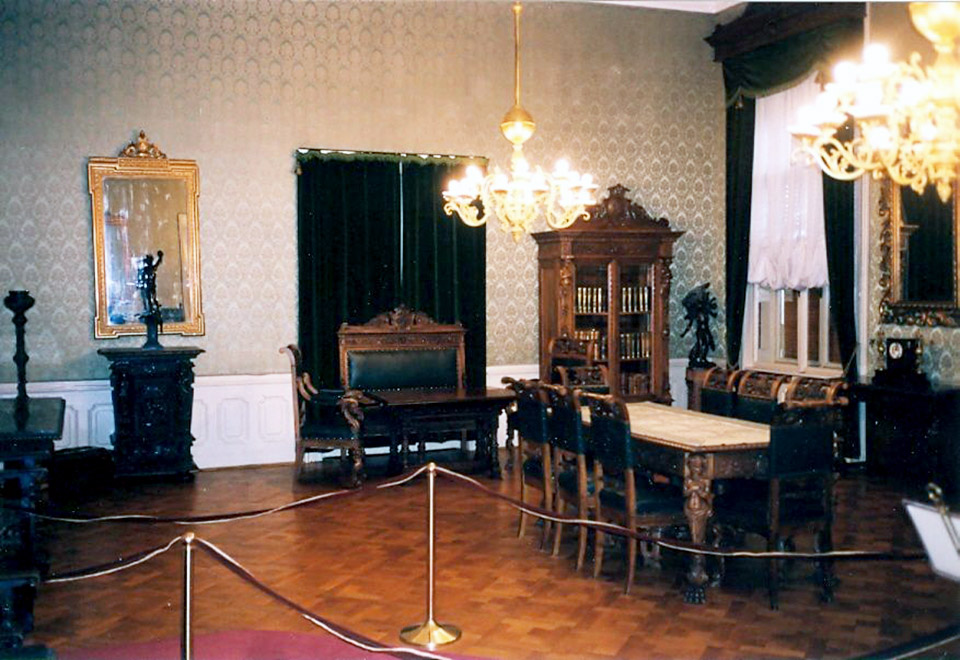
The room was named the Green Salon after it was redecorated in 1938 under Italian rule when, together with the other rooms on the first floor of the eastern part, it was turned into a representative space. That is when the previous red wallpaper was removed and the new, green silk wallpaper was installed, the woodwork was coated with oil paint and the parquet flooring was sanded and varnished. It became a dining room, and its adjacent rooms were turned into a salon and a smoking lounge. The Italians arranged guest rooms on the second floor, right above the representative salons, and introduced a new, independent heating system by which the eastern part of the Palace could be heated individually, based on need, when guests were staying there.
The administration of the Italian Carnaro Province stayed in the building until the end of World War II, when the Governor's Palace was turned into the city’s centre of culture. Numerous cultural, educational and public events took place under the auspices of the Central Culture Hall, while until the 1950s the Green Salon was used to host the Presidency of the City People's Committee.
After the Museum assumed management of the Palace in 1955, it tried to preserve the ambience of the salons on the first floor, and exhibitions were rarely displayed there. There was only one exhibition on display in the Green Salon – the 1963 exhibition on the work of August Cesarec to mark the 70th anniversary of his birth.
The Green Salon was thoroughly renovated in 1970, ahead of then Yugoslav President Josip Broz Tito’s visit to Rijeka for the 25th anniversary of the city’s liberation. The walls and woodwork were painted and the worn-out wallpaper was replaced. Both the Yellow and the Red salons were renovated in the same manner.
In the 1970s, the Salon was leased to various companies and embassies for business conferences.
To mark the 100th anniversary of the Palace’s construction in 1996, the salons on the first floor were renovated and used to display museum materials intended to show the changes in furniture styles from the 16th to the late 19th centuries.
Today, the Green Salon is part of the Museum’s permanent display. Preserving decorations from the time of Italian rule, it exhibits Rijeka’s political history from the 18th to 20th centuries (the Rijeka Governorship).