
YELLOW SALON
The original name of this room, as indicated in the design by Hungarian architect Alajos Hauszmann, was the waiting room (Hun. váró szoba), which indicates its original purpose.
The room is connected to the Atrium, the Marble Hall (originally the ballroom), the Green Salon (originally the reception room) and the conservatory terrace. The walls were painted olive-green, and the woodwork with faux mahogany paint. The shade of green chosen for the room’s walls was often used in historicist buildings. Documents show that a reading table covered with velvet was ordered for this room after it was constructed, along with two window curtains that were not preserved.
After the last Hungarian governor relinquished his authority and the Palace, this and all other rooms on the first floor were used as offices until 1938 and the thorough renovation of the Palace under the Italian rule.
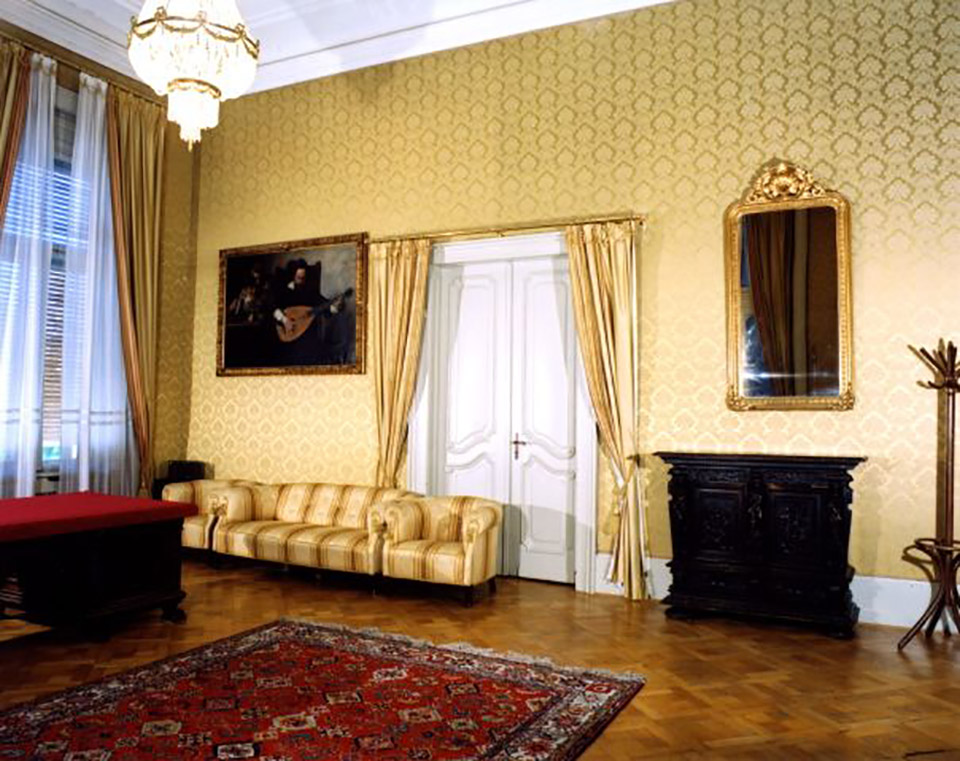
According to the restoration project, this and the other two rooms in the eastern wing of the first floor were to be turned into salons, while guest rooms were planned right above them, on the second floor. Such an arrangement allowed for savings in heating costs, as the rooms were only heated when distinguished guests stayed there. The salons on the first floor (the Yellow, Green and Red salons) were decorated in a typical style, the walls were covered with silk wallpaper, the stucco-work was restored, the woodwork was coated with oil paint, and the oak parquet floor was repaired.
The room’s walls were covered with yellow silk wallpaper, after which it was named the Yellow Salon, as it is still called today. Its purpose was also changed and the former waiting room was turned into a salon, from which one could enter the dining room set in the adjacent Green Salon. Following the logic of giving each room a function, the need arose for a salon for rest and socialising, therefore the Red Salon – a smoking longue – was furnished after the Green Salon (dining room) was finished.
The Green Salon was restored in 1970, together with the other salons on the first floor, ahead of then Yugoslav President Josip Broz Tito’s visit to Rijeka for the 25th anniversary of the city’s liberation.
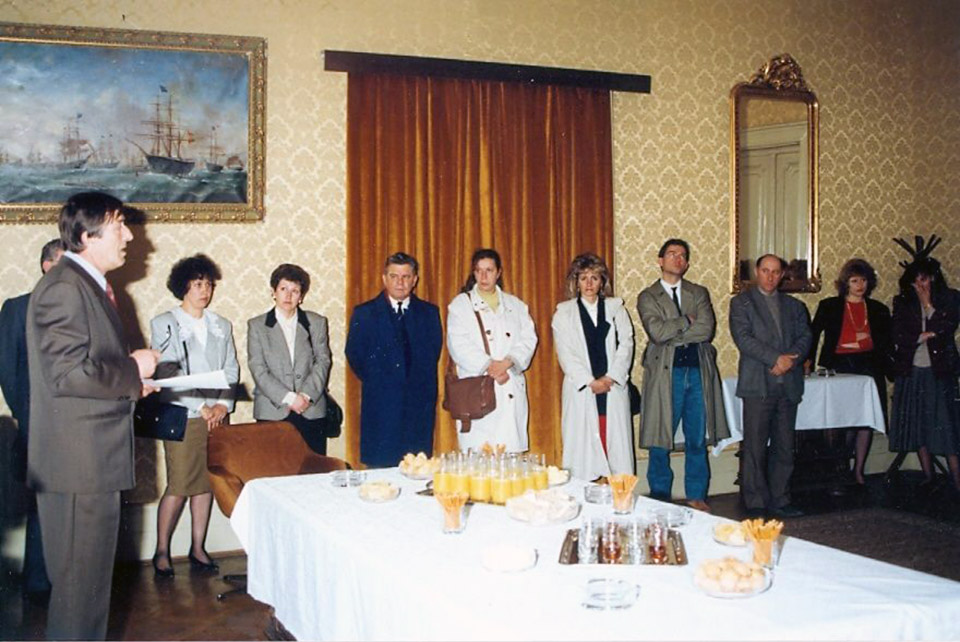
After World War II, when the Palace no longer served a political function, it became the centre of the city’s cultural life and the Yellow Salon was used for social gatherings and formal receptions. During the 1970s, the salon was mostly leased to various companies and embassies for business conferences.
Numerous movies were filmed in the salon, and in 1984, the Registrar’s Office, after losing its premises, used the Yellow Salon for wedding ceremonies. Even though it was only a temporary plan, a permanent contract was signed with the City of Rijeka the following year and ceremonies were held in the salon until 2016, when its thorough restoration began and the Registrar’s Office began using the Marble Hall.